WhatsNew VideoClip by G.Mattson (Also historic video clips from Okinawa)
Postings of interest by George E. Mattson
New Black Belt Test Guide, 3rd Edition is now on the market as an e-Book. What a great teaching tool. Instead of photographs, I was able to link text with internet video clips. It's free to current IUKF members and all new members. If you are a paid-up member and want your book now, please send me an email and it will be sent right out. Oh yes, Mac users can read this special formated book using the new PC emulator that Apple just released as an add-on to their computers. Of course Window users will be able to load and view with no trouble.
==========
| Why not get the complete 2hr DVD? Click Here |
|---|
I won't go through all our authors, but the next time you go to our store (Very easy to do, look to your left and scan down the table of contents) spend a few minutes checking the offerings. And for you book collectors, be sure to pick up one of the remaining "Scissors, Rock, Paper" book by Harvey Liebergott. Really an excellent martial art book that should be in your library.
=================
Everyone has probably heard the rumor that I've been working on a new book that will be published in 2008. Well, the rumor is true. One of the reasons I've not been as active on the forums as usual, is that I've set up a work schedule for myself that includes four hours a day devoted to the book. With luck, the book will be available for next year's camp.
==========
IUKF members will notice that they now have access to many new features and capabilities. "With membership comes rewards"! :)
Aside from the accessing more web features, you can now use the Uechi-ryu website to post articles, ask questions and generally be part of the publishing process involved in maintaining and updating the site.
I suggest that you get started by going to the left frame (Table of Contents) and click the "Submit News" link. You should see a small pencil icon in the upper left corner. Clicking on the pencil will open an edit window, where you can type text, add photographs and link to websites or articles.
When you are finished, just click on the "save" icon, located on the top of page, next to the "cancel" icon.
If you are a registered IUKF member and haven't been upgraded to "editor" status, please send me an email with your name and IUKF membership number.
=========
Note to first time visitors to Uechi-ryu.com:
Although this site shares the same server as our popular Forums, they are completely different programs, run by different software. Registration information you use for the forums will not work here.
If you wish to access some of the features here, please register. (You may use the same username and password as the forums)
The table of contents on the left is organized alphabetically, by general categories. Communications, for example, will open a "drop-down" menu for a number of "communications" areas, such as different Forums and our on-line learning center. Only IUKF members will be able to access other features , such as our video section, Learning features and Archives. IUKF Chairman, Dr. Paul Haydu will be reporting news and developments relating to the Federation and I urge you to get involved and join.
Bill Glasheen and his team will continue to conduct the FireDragon Challenges at all events. Everyone who qualifies for this rather unique and difficult activity will be awarded a really nice shoulder patch and a beautiful lapel pin. Only those who pass this challenge will be able to own these trophies and I hope they will be worn proudly.
Bill is also working on a FireDragon Challenge booklet, for dojo and other organizations who would like to conduct their own "challenges" and who will be able to award the FireDragon crests and pins to their members who pass the test. As participants at the camps discovered, this test is really tough and is indeed a "challenge".
IUKF, as an organization, believes that the martial arts revolves around building an individual's self-protection ability and. . . we also believe that the individual must be in excellent physical condition to use that self-defense ability.
The FireDragon Challenge (which is copyrighted and trademarked btw) is a well thought-out challenge, that tests all elements of our martial art abilities. It can be performed by the newest student (or non-martial artist for that matter) and the most advanced instructor in your dojo. It is a "challenge" that can accompany the student along his/her martial art journey. The formula that Bill has created to score the various elements of the "challenge", takes many of the candidate's personal history into consideration, making the scoring of the test one of the key factors in the "challenge".
If your dojo or organization would like to get involved with this program, please contact me for information.
==========
Thoughts. . .
I had mixed feelings reading the forums the past few days, as it appears that a few of the posters elected to single out a rather prominent Okinawan teacher and his "extreme" methods for "testing" his students while they perform the kata Sanchin. Having been on the "receiving" side of Mr. Takimiyagi's "checking" of Sanchin many times, I can honestly say that his interpretation and application of Sanchin "checking" is hazing at its worse, dangerous to the student and accomplishes nothing. Fortunately, his abusive behavior towards students is not shared by many of his Okinawan associates.
I'm mentioning this publicly, because there are many people who visit our web site that might get the wrong impression of Okinawan Uechi-ryu, based on the one-sided posts regarding a small minority of Okinawan teachers.
Interestingly, I haven't received any messages from people either wanting to defend Mr. Takimiyagi and his methods, (even though he has many students in the Western world), or complaining that our forums were "trashing" a time-honored and accepted tradition where seniors abused juniors while the junior students stand obediently at Sanchin "attention".
This isn't the first time I've written about this ritualized hazing. As pointed out in many other editorials on the subject, this extreme form of checking a student's Sanchin came about during public demonstrations, where the dojo attempted to entertain and impress their audience with the strength of their students. The younger students brought back these demonstrations of strength to their dojo where, in spite of warnings by their teachers, began to practice their Sanchin with other students, turning the sensitive "checking" into bone crushing competitive matches.
Naturally, as a young American serviceman, I was easily convinced that this version of Uechi-ryu was much more to my liking than the old version used by the senior masters of the time.
There aren't many Western Uechi-ryu teachers who hasn't heard both sides of the arguments for and against "extreme" conditioning and testing. Many of the now-senior Okinawan masters of Uechi-ryu grew up being taught by the old masters in the old way while experimenting with the "extreme" ways whenever possible. Some of the now-senior masters believe the hard conditioning and hazing is part of the discipline martial arts must contain. Some, like Mr. Takimiyagi, believe that Foreigners (Americans especially), need to be beat while standing helplessly. Some of our American seniors used to feel it an honor to be beaten-up in Sanchin by the Okinawans and would encourage their associates and students to "get in line for another Sanchin", and the privilege of being "tested" by an Okinawan master.
Now that the foreigners have "grown up" in their understanding of Uechi-ryu and the martial arts, some are beginning to questions the motives and purpose for some of the rituals imposed on them. At the time people accepted the hazing as part of the mystical aura surrounding the martial arts. Now, they may suspect that they were simply being abused, with no logical reason behind the treatment.
We have come a long ways in our understanding of our Uechi-ryu. We will continue to learn and benefit from what we are doing and discovering. Yes, there are some bumps in the road, but lets not dwell to much on them or let them destroy where we are headed.
=========
Festivals & Haunting memories. .
I was invited to participate in a local "Body-Mind-Spirit" Festival last week. Susan and I thought it might be fun to meet some of our neighbors who considered Yoga, Tai massage, Organic Light-filled food and perhaps karate, as normal and wholesome. I brought along a couple martial art dvd featuring the 2004 SummerFest, a bunch of my "Black Belt Test Guides" and lots of literature to hand out.
Unfortunately, the martial arts down this way is nothing like New England where Uechi-ryu abounds. Here, the standard fare is TKD and in most of the schools where my new friends study or studied at one time or another, the emphasis is on teaching children, not adults. In my fledgling dojo, most of the students are adults and my literature focused on benefits Uechi-ryu offers for men, woman and children of all ages. I don't baby sit and therefore I won't accept a child unless they are toilet trained and can follow instruction. :)
Because my dojo is so different, we are viewed with some skepticism and trepidation.
"You mean you do drills where people hit one another?"
Well, the good news is that quite a few former students of other "real" dojo dropped in and were very interested in studying. Unfortunately for them, all the "real" dojo went out of business for some reason or other and the students were left with few options. I'm feeling a lot like I did in Boston in 1958, when no one even knew what the word Karate meant!
I was pleasantly surprised, when one of my students brought over a woman to our booth, who wrote a book on the aftereffects of the Vietnam war, called "Voices from Vietnam". The author, Charlene Edwards, a photographer, writer and explorer, has had her work exhibited in many galleries and has been published widely. She and her husband, Michael, (A Vietnam Veteran) recently moved to Florida from New York.
 We talked a lot about her book and the reasons she wrote it. I was interested, because what is happening today in the Mid east, is looking more and more like another Vietnam. Have we learned nothing from that war?
The Americans called it the Vietnam War; the Vietnamese refer to it as the American War. By whatever name, it was a great tragedy. Three million Americans served in Vietnam; over fifty-eight thousand of these men and women did not return alive from its jungles, rice fields and cities. Nearly four million Vietnamese soldiers and civilians on both sides were killed or wounded. By war's end, more than 2,200 U.S. soldiers were missing in action, as were 300,000 of Vietnam's own sons and daughters. The Communists interned a few hundred thousand vanquished soldiers and South Vietnamese officials to reportedly brutal "re-education" camps. More than a million "boat people" fled their ancestral homes in leaky vessels to escape the continuing nightmare and nearly 400,000 died in the attempt. There was virtually no one in Vietnam whose life went untouched.
The war cost the American people billions of dollars. It left the Vietnamese country in shambles and its infrastructure in ruins. six million tons of ordnance were dropped on Vietnam (the equivalent of a 500-pound bomb for every human being in that small country) -- more than three times the amount dropped during World War II. Left behind were huge depressions in the rice paddies where the bombs fell. Many have filled with stagnant water and now harbor malarial mosquitoes. It is estimated that twenty million such craters litter the landscape.
... After its soldiers came home, America wanted to forget about the war it lost. There was almost a conspiracy of silence surrounding the war. Even the veterans and their families rarely talked about it. But, whether it was talked about or not, combat changes a person, sometimes beyond all consideration. For most veterans, spending time in a war zone created a bitter battlefield inside and emotional wounds that won't heal.
Charlene visited Vietnam in 1992 and was drawn like a magnet to this beautiful place that had haunted her soul for years. She photographed the country and the people during the day and spent the evenings listening to the stories of people she met, who were affected in some way by the war.
Returning home, she began compiling the stories of the amazing people she met. Her experiences in Vietnam made her curious to know more about the American soldiers and nurses and the Vietnamese in America. Not only the South Vietnamese, but those from the North as well.
This is an amazing book that is difficult to put down. There are so many stories to tell, highlighted with Charlene's beautiful and colorful pictures. The reader is drawn into the effects the war had on participants and family, both during the war and now, many years later.
Robin Moore, author of The Green Berets and The French Connection wrote the foreword and a glowing tribute to the author and book. I can only add my recommendation and hope that all who read these words will purchase a copy. The best place to purchase her book (and get it autographed) is on her website:
--------------------------------------------------------------------------------
This n That. . . .
So you think you are tough!!
On our forums we get lots of advice of questional value. Those of us who are not in law enforcement fantisize about what we might encounter during our next visit to a local bar or while walking home from the theater. We spend a whole lot of time playing the "what if" game, critiquing one another's methods and strategies, pointing out why one way is better than another.
In some ways, these discussions resemble computer game discussions, where all participants have the same potential and weapons; where age, physical condition and mindset are not factors. You can play the game in a wheel chair or while handicapped with a broken leg.
Nowhere in the discussions do we factor in all those critical components that are probably much more important in a real fight than the argument whether a grappler will beat a stand-up fighter!
Personally, I enjoy reading comic books whenever I wish to fantasize. . . or play my Doom 3 computer game whenever I feel the need to wipe out a bunch of ghouls.
When I really wish to talk about survival and living the good life, I call my new friend and 10th degree black belt in life, Bud Iman. Bud is 90 years old and my new self-defense advisor! In addition, Bud is one of the best golfers I know. He hits the ball around 175 yards off the tee, right down the middle. The rest of his game is pretty good as well, but his putting rivals Tiger Woods!
His only advantage on the course is playing off the orange tees, which is a few yards closer to the green than the white tees that I play. He and his playing partner beat my team on our first outing. You should have seen the smile on his face as he took my three bucks following the match!
When he found out that I was a karate teacher, he smiled and asked me if he could join the class. I asked him if he was being picked on by someone and he told me: "Hell no! I just want to be able to defend myself against those young 70 year old women that keep pestering me!"
I plan to interview this 90 year old next time we play golf. Somehow I feel that his secrets for surviving all those years doesn't have anything to do with realist drills or self defense courses. Bet he has a couple of common sense rules he instinctively followed, a beautiful punch he could count on in an emergency and lots of advice on simply enjoying life.
I bet he is going to make a real fine karate student.
=========
I'm really excited about the progress being made by the IUKF's new Board of Directors, chaired by Dr. Paul Haydu from California. I've been invited to sit-in on their weekly On-Line meetings and marvel at how hard these five guys are working to overcome all the misinformation and prejudges that have stagnated the martial arts generally and Uechi-ryu specifically for the past 20 years.
Dr. Haydu's first order of business has been to create a public relations kit, introducing the board and outlining the benefits and basic philosophy of what IUKF hopes to accomplish. "Our main goal is to overcome the isolationist attitude of some teachers and organizations", stated Dr. Haydu, "although some of this attitude is self-serving on the part of the teachers, it is not in the best interest of the style, the dojo and especially the students."
IUKF has proven through the years that working together, encouraging students to get involved in non-dojo activities and expanding their experiences makes good sense. Students are normal people, capable and eager to expand their martial art experiences and knowledge. Teachers who try to protect their students by subtly and not so subtly boycotting outside activities and outside-the-dojo contact are missing the point completely. Students may buy into the "I'll teach you everything you need" for awhile, but sooner or later they will discover SummerFest or will sneak out to attend a seminar. Once they discover what they have missed, they aren't very happy and often are very upset at being duped by their teacher.
IUKF isn't trying to replace your teacher, your promoting organization or the method of your training. It has limited and fairly specific guidelines involving teacher codes of ethics and conduct along with student rights that are essential in this age of abuse and cultism that are rampant in the martial arts.
People belong to many organizations. The martial arts has been laboring under the misconception that the teacher is some kind of guru, who knows all and deserves unquestionable loyalty and respect. Too often, students discover all too late, that the guru's shiny coat of armor hides a rotten interior. The martial arts should be viewed as an activity, no better, no worse than any other activity. To attempt selling what we do as something else is both unethical and deceiving. Allowing students to belong to an independent fraternal organization such as IUKF should not be viewed as a threat to what might be considered by some teachers as "private property".
Students and teachers are invited to send IUKF's secretary David Berndt an email, requesting an information kit. Please include your mailing address.
We've had many years of non-cooperation and elitist isolation with stagnation and no growth - Lets try working together to see if we can build our dojo and the system. GEM
Doing what I enjoy doing. . .
Last week I began classes at the local Seniors Community Center. Although I have room for 250 students, only two people showed up! :(
Since I'm a pretty "upbeat" kind of guy, I didn't take this personally. After all, the two who showed up were Uechi-ryu black belts already and received special invitations to attend. Of course, there is no reason why hundreds of other people didn't show up. . . other than the fact that I haven't done anything to publicize or advertise the program.
Do I intend to be bragging years from now how I only take the very best students... you know... those guys who can punch through brick walls, never miss a class, or do I want to be telling everyone six months from now how my dojo has 100 dedicated students?
Anyone else out there asking the same questions? If so, listen up. . .
"So you want to open a dojo!", is the topic of IUKF's first On Line Learning program, to be held Tuesday, March 15th at 8PM (EST). I've had lots of experience opening dojo and since its been quite a few years since South Boston, I figure this on-line meeting will as important to me as a brown belt who has always dreamed of owning his/her own dojo.
Gary Khoury and I spoke about this subject at length yesterday. He said that things have changed a lot over the past 10 years. Today a dojo owner must be prepared to work hard, invest lots of money and know the "dos & don'ts" of dojo selection, renovations, management and marketing. Gary will be among the guest speakers at this first session. We will only have room for 25 people and you must have internet connection and a microphone to participate. Email Harry Skeffington to reserve your space and receive your username and password.
[Note: we plan to offer more of these seminars. Watch the home page for information]
==========
If you haven't subscribed to my Newsletter, join the 3700+ who enjoy reading about whatever is bothering me, making me happy or anything else that I find interesting. It free, easy to sign-up for and easy to unsubscribe. And unlike other newsgroups and lists, I pay for this news service so my subscribers names and email addresses remain private.
SUBSCRIBE TO OUR FREE MONTHLY NEWSLETTER
Later. . . GEM
Looking Ahead!
Is it possible to enjoy a place too much???
Right now, I'm sitting in the sun room at the back of our house, overlooking a beautiful wooded backyard covering nearly twenty acres of conservation land. Instead of loud boom boxes blaring from low slung pimpmobiles on Rt 123 in Brockton, I listen to a strange and beautiful assortment of song birds frolicking in the bird bath and trees.
Let me tell you. . . it is very difficult to concentrate or do any work. Tia joins me often here, trying to discover where those strange sounds are coming from and why no cars or people!
The locals tell me we won't always have this perfect weather. I can expect a couple of hot months during the Summer. Might have to close the sun room and turn the AC on. . . On the other hand, thats what I had to do in Brockton. . .
Actually, I've been working quite hard since getting settled in following the move. The new board of directors and I have been completely revamping IUKF in an attempt to break down all the political BS that will continue to keep Uechi-ryu from growing.
Darrin Yee stated the problem most accurately when he said IUKF should focus on non-competitive activites and services instead of things that further sever relationships and provide excuses for the teachers to use for encouraging their students to isolate themselves from other dojo and instructors.
Although tournaments are fun and should be an important part of a student's Uechi experience, when unfriendly dojo meet in tournaments, affiliations don't usually result.
-------------------------------------------------------------------------------
While waiting in the Chiropractor's office today, I was scanning the magazines and noticed an article about "Why kids aren't playing sports today". A couple of big league baseball players, coaches and parents were interviewed and they all blamed the parents for "taking the fun out of sports" for the kids. They related some real horror stories of fighting, yelling and screaming at the kids and downright boorish behavior on the part of the parents as they coached their kids in little league, soccer, football and other sports.
The kids are rebelling by not participating!
Well, maybe the karate kids' moms and pops are different. During the whole, long day of my tournament, I didn't see one parent get upset at the officials or their kids. I did see lots of hugs of encouragement and "high five's". . . whether the child came in first place or tenth place.
All of the successful dojo I am familiar with, work with the parents and the kids. The kids get the lessons and confidence. The parents get the benefits of their children's lessons with higher grades in school for their kids, respectful treatment at home by their kids and a generally happy relationship with their karate kids.
I just wanted to take this opportunity to thank all the parents who support and encourage their children as they pursue that elusive black belt. It has always been my feeling that when the child receives his/her Jr. Black Belt, the parents should receive one as well. :)
=======================================
Lets talk Sport Uechi-ryu!
I'd like to discuss the subject of Sport Karate today. Competitive martial arts is misunderstood and unappreciated among traditional martial artists. The reason for this comes from a couple of justifiable reasons:
1. The original rules were ambiguous and seldom read or understood by the competitors.
2. Officials were untrained and seldom followed any rules.
3. Tournaments were dangerous because some students were fighting "full contact" while their opponents fought using the rules.
Some of the less realistic reasons for not competing in sport karate events:
1. Uechi-ryu (or substitute any style) is too dangerous for competition.
2. My students are trained to use "killing blows" and cannot pull their techniques.
3. People who spar successfully, cannot use their style's stances or techniques. They all eventually resort to generic methods that obliterate their style's uniqueness.
4. We can't use all the weapons of our style in competition. Therefore we are handicapped.
5. Competition creates habits that offset our style's effective methods.
6. Teachers encourage their students to salvage the teacher and his dojo's reputation by getting disqualified rather than lose honestly.
Other excuses come to mind, but these are enough to get my point across.
I organized and ran one of the first karate tournaments ever held in North America back in the 60s. It was well run, with few rules and many conscientious officials who attempted to determine the best fighter without anyone getting killed. Within a year, dozens of tournaments were being run throughout the country, each with its own rules and officials who interpreted those rules as they wished.
I organized the first officials' organization in the 70s, recognizing the importance of having trained officials who were capable of fairly enforcing the rules.
But a number of the unforeseen problems no one had answers for killed tournaments for the next generation of martial artists and influenced the direction Uechi-ryu's version of sport karate took here and on Okinawa.
The main culprit was defining and enforcing rules regarding "contact".
The second culprit was people who insisted that sport karate training methods must come from their traditional style instead of allowing the sport to develop, using traditional methods as tools and foundation. Instead of building the sport with an open mind, traditionalists were handicapped by legends and misconceptions about the infallibility of their teachers, peers and themselves.
Egos, politics and an unwillingness to evolve has killed sport karate within much of the traditional Okinawan karate world. Fear of the unknown and unwillingness to accept traditional martial arts as little more than historical ritual, has prevented much of the Uechi world (and other Okinawan systems) from benefiting from the challenge and appeal found in sport karate.
I wish it was possible to credit my senior students or myself with the resurrection of sport karate. What I had attempted and failed to do many years ago has been accomplished by the AAU and the WKF. The founders based their rules on traditional techniques, performed in a disciplined and controlled manner.
Not many martial artists will say that sport karate hurt the development of the top fighters within Uechi-ryu or other styles. I'm convinced there would be a lot more highly respected competitors had Uechi-ryu and other hold-outs embraced the AAU and WKF tournament methods years ago. Instead, the seniors continued to hold on to the dangerous and misguided belief that sport competition had to remain uncontrolled, dangerous and completely unfair to any competitor who actually was foolish enough to follow the rules.
Anyone who decided not to compete under those conditions was branded a coward (or worse) in the minds of those who braved the odds of getting hurt and continued to test themselves under the most difficult conditions.
I personally believe that much of the outcry from Sport Karate detractors, comes from those who are simply (and with good reason) afraid to have their students exposed to this danger unnecessarily and create all kinds of justification for not supporting sport tournaments.
I know, since I was one of those teachers for quite a few years.
There are three types of Sport Karate tournaments still being held in America.
1. The Open events account for 95% of all participation. The rules are well understood by all who attend. The officials don't have to be trained, since the object is "tagging" your opponent. The key here is that the competitor need not use good form or technique. You simply have to tag you opponent. Injuries are very, very rare.
2. Hard contact, old-style tournaments. Pretty much a throwback to the way things were done. Very few of these events are being held today, but once in awhile an "oldtimer" will come out of retirement and run one. Very dangerous and few rules.
3. Taekwondo Tournaments: They don't use hands. Emphasis in on kicks.
4. AAU/WKF/ events. Emphasis in on "tagging", but with excellent form and technique. Although very popular outside of the USA, there are very few of these events being held here at this time.
Currently there are no ADULT Uechi-ryu tournaments being held anywhere in the world except my Uechi Championships. Since all of the past tournaments were run under the #2 category of rules and because of the inordinate number of injuries, there is little chance of anyone trying to run one in the foreseeable future.
So why have I been banging my head against a wall these past ten years, continuing an attempt to rebuild sport competition in the Uechi world?
Mostly, because I am a firm believer in the value of sport training as an integral part and partner of traditional Uechi-ryu. Partly, because I'm stubborn and refuse to believe Uechi practitioners are incapable of following a training routine, based on their root system, that can be used safely in a ring. We are looking for controlled movements, disciplined actions, good balance, excellent distancing ability and a warrior spirit. How do these skills hurt your traditional Uechi-ryu?
Show me a top WKF fighter and I'll show you a person that any teacher would be proud to have as a student. He/she will be able to perform kata as good or better than any other person in that dojo. He/she will be able to perform any bunkai as good or better than any other person in the dojo. He/she will have the potential to defend him/herself in any dangerous situation as good as or better than any other person in the dojo.
Open tournaments attract over 1000 competitors per event. Even the small ones get 5-600. Why should I continue to restrict my tournament to Uechi practitioners and use rules that few Americans understand?
Because I don't believe the Open events or the "old" style tournaments are best for a traditional Uechi dojo. Because I believe building competitive students in a Uechi dojo, using WKF standards, helps build better Uechi students.
If what I'm doing catches on and other Uechi teachers recognize the value in this type of competition, the AAU/WKF events will catch on elsewhere. Then we will hear fewer excuses as to why sport karate is not compatible with the "real" karate.
The key to success is understanding and acceptance of the rules by competitors and officials. To work, the rules must be tied to the sparring training in the dojo. This doesn't mean eliminating the rest of your Uechi training, but it does mean opening up your mind when it comes to sparring. In the old days, sparring was simply something we did after the formal part of the class was over. There was no link to the traditional system. . . Students just got out there and mixed it up.
Today, anyone wanting to enter a legitimate WKF event with this background would find themselves completely outclassed. To become a skilled fighter, you must train using the tools of your Uechi-ryu with drills and practice routines that are completely foreign to the average sensei.
We can continue to proudly hold up our Uechi certificate and extra long belt and talk about how tough we used to be while remaining totally ignorant of what it takes to build a competitor capable of competing in a truly world-class event. Or we can get up off our collective butts and get out there and learn and train ourselves and our students in something new and exciting. Spend a year DOING . . . Then determine if the training has hurt your Uechi or if as I suspect, you will discover that you and your students have actually become better at everything you are trying to accomplish in your dojo!
This is not about politics or the patch you wear on your shoulder. It is about building a strong Uechi dojo with students who are fit and healthy. It is about taking your Uechi to another level. It is about dispelling all the old and petty excuses for not learning something new. It is all about your students……
This is not about what is "real" Uechi and "unreal" Uechi. It is about training students to be disciplined fighters using traditional Uechi techniques with traditional Uechi mindset. It is about translating everything done in the dojo to the ring.
George E. Mattson
=========
Trying to figure out what the "experts" are saying!
OK, we've read all the posts. We've read and reread countless excerpts from countless experts, exalting dozens of "correct" breathing methods. We've listened to why we should not do pre-arranged drills while others tell us the latest in "can't miss" pre-pre arranged" drills. We've been told how "Kanbun did it!" by one expert while another tells us to abandon the "old ways."
I don't know about you, but I'm thoroughly confused! Apparently, I'm not the only one scratching my head while trying to figure out what the "experts" are really saying and how to make sense out all the conflicting and in most cases, diametrically opposed advice.
While in Florida, one of the teachers I was working with expressed his concern over the lack of direction and support for the traditional martial arts by the leaders, who this teacher believes, should be strengthening the system instead of being so critical of the majority of dojo and instructors.
Most teachers are afraid to voice their opinions, unless they jive with whatever the more vocal seniors are promoting in the way of training philosophies. The problem, according to this teacher, was that the experts are very good at "tearing apart" the typical dojo but are doing very little in the way of supporting and building them. Students, reading these conflicting viewpoints, don't see them as options, but instead as guides and measuring rods by which their instructor and dojo must be judged.
Accurate assessment or not, this appears to be a common place perception among the silent majority of dojo and teachers "out there".
I countered his argument by saying that the there was no single way or method in the martial arts. Just as every individual must eventually build his/her own system, every teacher has his/her own way to present the art in their own way. I attempted to explain how the martial arts is not all that much different than the game of golf. Although the object of the game is to strike the ball with a variety of tools, there are literally thousands of different methods and approaches to doing this.
The difficulty with accepting this open-minded attitude in the martial arts lies in the fact that the "experts" often attribute a sort of mystical quality about their abilities and how they acquired this ability and the source of their experience. Anyone who believes they have a lock on a style by virtue of their background, teacher or historical link to someone, may unintentionally appear to label anyone not possessing all of these qualities as being inferior and what they teach as being flawed. Nothing to judge this belief. . . No ball to hit or putt to sink as a measure of skill and justification for belief of superiority.
If we all stopped trying to find that elusive "perfect", "undisputed" and "ultimate" system. . . or even to believe that such a thing actually exists, we could approach the subject of martial arts and self defense in a more objective and agreeable manner. . . for my skeptical student in Florida and probably the majority of practitioners who read our forums looking for ways to improve their martial arts.
Following my seminar, I spent quite a lot of time thinking about why martial artist have this problem experimenting with different training methods or even reading about variations in techniques. My conclusion involves both the way we perceive the role martial arts play in our lives and the way our instructors portray them as a fixed and complete system that must by mastered instead of explored and used.
The best way to break that mystical hold the martial arts has on its practitioners, while maintaining all of the benefits and traditions, is to view it through a model which can be easily understood and related back to what we do. For some reason or other, it is easier to relate to a subject that is not so steeped in ritual and perceived historical relevancy.
Bear with me for a minute and lets explore the model which I believe will help us understand our martial arts while demystifying the process of learning and practicing self defense.
The World of Driving Compared to the World of Martial Arts:
If we put aside all the ego traits that influences the martial arts and view them as we do driving a car, the exercise will help us demystify the art while shedding some insight into what the "experts" are really attempting to offer us in the way of advice.
Every time we enter a car, we put our life in danger. Ironically, we are in far more danger while driving to the Mall then we are walking around the facility looking for items to purchase.
We practice a far more complex set of actions and reactions while driving a car than we do while negotiating our way through a park or walking down a deserted street.
We can learn how to drive from our parents, friends, sibling or we can attend a school for the purpose. There are different styles of teaching students how to drive. Interestingly, many of the same concerns and situations involved in driving are also subjects of martial art classes.
There are highly specialized versions of driving.... everything from different tests involving racing to offbeat, somewhat extreme demolition derbies. My friend "Mad" Max Papis is an expert at the very difficult art of road racing. This skill involves not only the ability to have the very best tools of his trade, but to use these tools with physical and mental abilities he was born with. Some of us might be able to develop a measure of the kind of speed of reflex, timing, reaction and hand/eye coordination that Max possesses, but we would be delusional to believe we could compete with him on the track.
Driving a car involves many of the same kind of techniques our "experts" discuss on our forums, that involve the martial arts. Much of that driving advice is common sense and has to do with awareness, pre-emptive actions, defensive maneuvers and techniques used to avoid danger and in the worse case, to deal with it in as safe a manner possible.
Finally, the condition of your equipment is a major consideration in driving safely and surviving with your self defense tools.
Hopefully I've gotten my point across. There are styles of driving as there are styles of the martial arts. There are highly specialized methods and uses for super conditioned drivers as there are for superior talented martial artist.
It would be foolish to tout "Mad" Max Papis as the model for what the average driving schools should be turning out and it would be dishonest for anyone to knock the driving school because his students couldn't out drive Max at Daytona.
Yet, this is exactly the perception that some students and teachers have when reading what our "experts" are proclaiming when they challenge a Uechi student to enter the UFC as a test of his teacher's or his ability.
Still, with all his natural ability and never ending training, even Max will lose races and have accidents. In his field, this equates to a martial artist getting beat up in a fight. Max's goal is to always win, but when the unexpected occurs, his objective is to survive!
When reading our "experts" advice, try to remember, in spite what the words sound like, there is no one out there that is going to turn an average martial artist into the "Mad" Max of Uechi-ryu. When training, be mindful of the common sense driving skills you probably take for granted and try to apply them to what you are learning in the dojo.
I read in this morning's paper, two deaths in Massachusetts caused by road rage. In both cases, neither of the participants would "back off" and instead escalated the rage until one lost both the ego battle and his life. Unless you are a "Mad" Max, spend at least as much time learning to control your ego and rage as you do standing up to the bully when no alternative exists.
Self Protection: The Role of the Traditional-based Dojo
I know we've discussed this before on WhatsNew, but quite a lot has happened in the world, the USA and within the Uechi-ryu community since that last editorial. Our website forums is a microcosm of our world that represents a small segment of the population and a fairly large percentage of the martial art world. Much of what I have to say on this subject is based on various topics discussed on our forums.
I always find it interesting that so many people "lurk" and so few actually participate in the forums. This means that a very small percentage of the people who read the forums, actually dictate the direction and thrust of the topics and dialog found there.
Some would speculate that the majority simply agree with what is being posted and signify their approval by continuing to read yet remain silent.
Others believe that the silent majority is much like the general population. They complain and are unhappy over the way things are run and over what has been said, but they don't vote, they don't write their representatives in congress and they don't express their feelings on the forums.
Whichever is the case, our forums seem to have taken a hard right turn towards realist training (whatever that might mean) and much confusion over what ""tradition"" represent and its place in the world of self protection and martial arts.
Although I believe in many of the "realist" mind set and training methods, I have a hard time giving up my "traditional" roots. "Mushin" is a lot easier for me to understand and work on than attempting to read and comprehend a book on the scientific basis for achieving a zero based mind set! :)
As I see it, there exists two extremes in the martial arts. Both see what they do as the best way to address the self-defense conundrum facing the fighting arts community.
Before continuing, I want to stress that we are evaluating positions regarding self-defense methods for civilians and not the military, police, swat teams, bouncers or any other group that must, as part of their job, put themselves in "harms' way" on a regular basis.
The "Realist" on the farthest outer edge of our model, doesn't believe in any part of the "Traditionalist" doctrine. To them, everything martial artist do is a waste of time or worse.
On the far left are those who believe that everything we need to take care of ourselves in a fight, is found in system of martial arts they practice. Weaknesses in performance can be traced to weaknesses in practice, understanding and faith in themselves and the style.
Obviously, most of us find ourselves in the middle somewhere, either amused at the radicals or terrified that we are being shortchanged by our teacher/s and our methods of training.
The irony of this argument is that neither method is best or even better than the other and even more ironic. . . neither method, even in its purest form, is any better for the average civilian, than what is being taught in a half way decent dojo throughout the world!
If all the groups out there, selling courses, videos, books, seminars, boot camps or whatever, had to meet the same standards for making claims as auto makers or viagra, the ads for those self defense claims would be lot easier to read and understand and a whole lot smaller.
We have learned a few facts by reading the forums:
-
If a skilled Bad Guy (BG) with a weapon wants you dead, you are dead
-
If an unskilled BG with a weapon wants you dead, you are probably dead.
-
If a skilled BG without a weapon wants to hurt you, your survival will have more to do with your emotional mind set than on the drills you practiced at the middle of the road dojo or high tech seminar you attended for three hours.
-
If you are really interested in self-protection, you should rely on a gun (legally obtained and carried of course) backed up with lots of range experience and specialized scenario training.
-
If you have been convinced that whatever you may have been taught or sold, has prepared you for a battle with a truly skilled BG, with or without a weapon, you may elect to engage rather than withdraw from a conflict, where that alternative was possible.
-
There are emotional consequences for believing that eventually you will discover the perfect seminar, teacher, course or whatever, that will give you the confidence and skills to deal with a life and death conflict.
The most disturbing realization remains. . .
Should you elect to engage, whether a choice was available or not and you have your weapon of choice ready, be advised that most people will be unable to actually pull the trigger or throw that destructive kick/punch when faced with that decision.
So just what are we discussing when we take a position for being a "traditionalist" or a "realist" on an issue relating to self defense?
In my opinion, we should spend more time attempting to define exactly what we are doing, why we are doing it and what we hope to accomplish in the process. I'd like to see a lot of the "hype" associated with both traditional and realist training methods toned down to reflect more honesty in the content instead of all the emotional arguments to "do it this way".
Probably most important in all this a a mutual respect for those people who elect to do one or the other, for their own reasons. For a "realist" to argue against doing "cooperative" drills is not something a "traditionalist" wants to hear. Especially when the "realist" uses an argument that is misleading and unproven by any reasonable scientific standard.
It would be just as unreasonable for a "traditionalist" to say that based on folklore and legends, a system without a makiwara and kata is unworkable.
In both arguments, the premise of superiority is based on undefined rationale and lots of assumptions. What bothers me in these types of "believe me" arguments, is that the real experts cannot validate simple and easily researched self-defense information on something as hard-wired as gunshot wounds. Certainly the "traditionalist" pointy finger and toe weapons cannot be studied with such precision. Can the "realist" and their tools, be any more certain in their beliefs, findings and recommendations, than the effects of a gunshot wound to a Bad Guy?
There are just too many variables involved in a fight, to make any suggestions as to outcome based on the system/s studied by the participants. Therefore, we are left with a number of potential methods and tools that were created to accomplish certain tasks, under conditions where other, unpredictable variables play a very large part in the encounter.
None better, none worse.
If we can all accept this simple declaration about what we do in the name of self protection, then those of us who are "Traditionalist" will be more willing to listen to "Realist" tell us about their new fangled drill with the latest knife and the "Realist" won't cringe when reading about the "Traditionalist's" old fashioned method for conditioning the shins.
There is one irrefutable fact that we should all recognize should this mutual respect scenario fail:
The majority of students come from the "traditional" dojo and the "realist" rely heavily on cherry picking exceptional students from these schools for their programs, certification and franchises.
The smart specialist like Tony Blauer, Dave Young and Scott Sonnon, when working with traditional dojo, are very respectful and sensitive to their audience. They are honest about what their tools are designed to do. They support the "Traditional" dojo by building on their traditions and methods. They enhance the root programs and don't try to replace them.
A win win situation for all and a huge lesson for both the hard core "Realist" and hard core "Traditionalist".
George E. Mattson
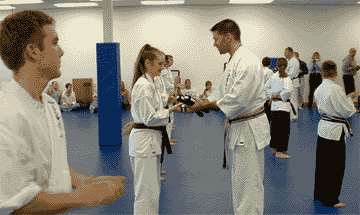 "The Role Karate Has Played In My Life" by Kelsey Morgan